
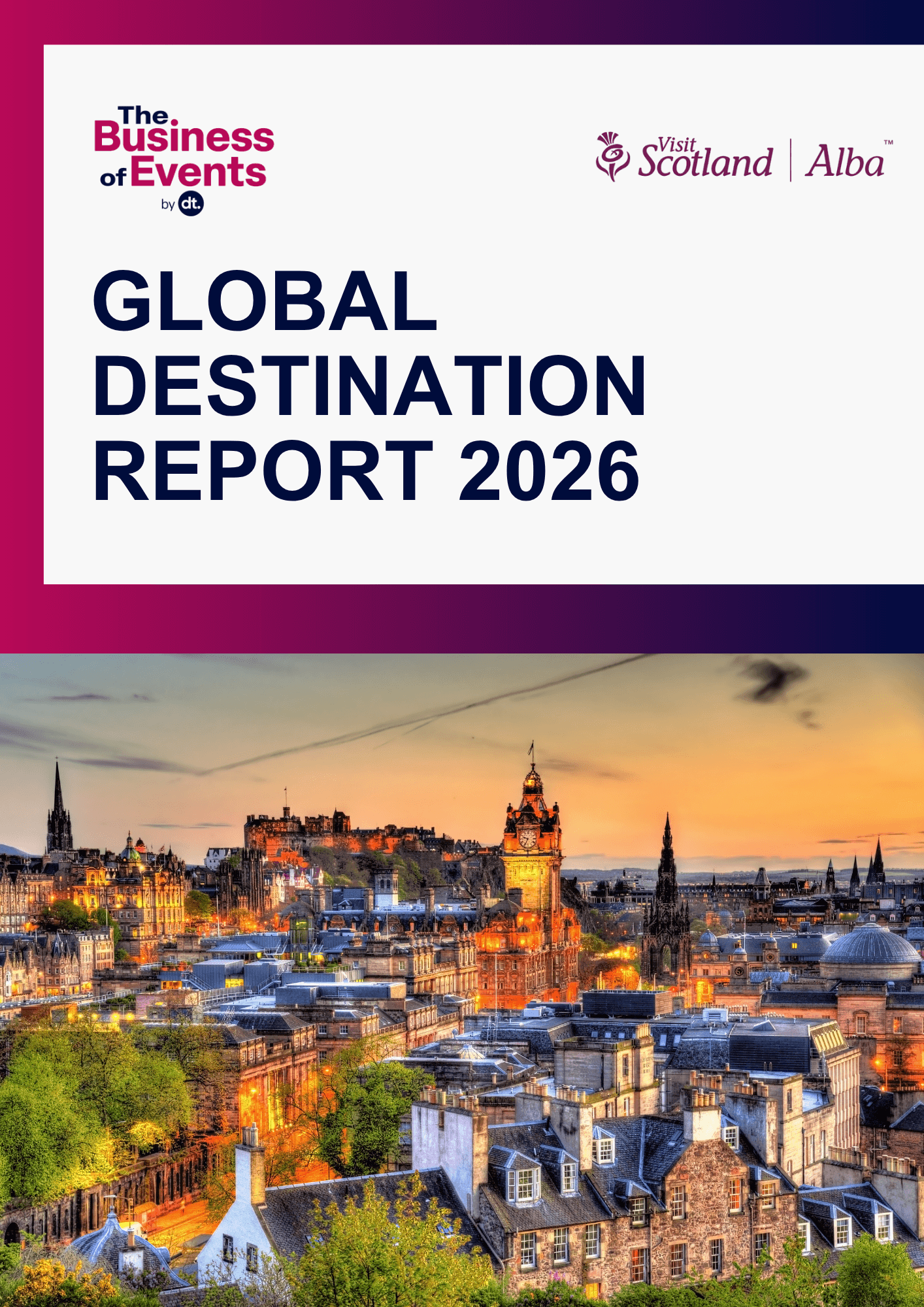
The Business of Events (TBOE), in partnership with VisitScotland Business Events, has launched its Global Destination Report 2026, revealing destination competitiveness is increasingly being shaped by value, connectivity, policy support and measurable impact rather than venue capacity alone.
Unveiled at TBOE’s Policy Forum at IET London: Savoy Place, the report highlights a resilient business events sector that continues to deliver significant economic value despite growing challenges around funding, resources and geopolitical uncertainty.
Produced in collaboration with SFA Connect, the fifth edition of the report draws on survey and interview insights sent to over 1,000 contacts at destinations worldwide and is designed to help destinations strengthen advocacy efforts and secure long-term support from policymakers. .
A spokesperson for The Business of Events commented: “The 2026 Global Destination Report helps industry stakeholders understand current challenges and opportunities in the business events sector, while also tracking trends over time. As our report shows, although the sector generates significant economic value for destinations, it continues to face budget and resource constraints, as well as an advocacy gap in ensuring this value is fully reflected in policymaking. We’re proud to provide information that destinations can use to secure funding and help make the case for the essential role business events play in economic and social development.”
Significant economic value
The latest report illustrates a business events sector that has transitioned from post-pandemic recovery into a phase of stabilisation. Survey findings show that performance remains positive overall, but growth is moderating, while interviews point to a more complex operating environment shaped by structural constraints and external pressures.
Business events continue to generate significant economic value across destinations globally. In 2025, just under three-quarters (68%) of respondents reported annual economic value exceeding €25 million, while nearly a fifth (17%) reported impacts above €500 million, including 7% who reported value exceeding €5 billion. However, economic impact remains unevenly distributed, with the highest-value contributions concentrated among a smaller group of destinations, particularly in Southern Europe and North America.
Resilience under constrained conditions
Event activity has stabilised, with the majority (around 90%) of destinations reporting stable or increasing volumes, while growth in economic value has increased in 2025 to 67%, following a dip in 2024 and after a peak in 2023. Notably, this improvement in economic value occurred despite over three-quarters (80%) of respondents reporting stable or reduced budgets, highlighting continued resilience under constrained conditions.
Association events continue to act as a stabilising force across the sector, consistently demonstrating greater resilience than corporate or incentive business during periods of uncertainty.
Tier-2 destinations are becoming increasingly competitive despite operating with limited resources, progressively leveraging closer stakeholder collaboration, walkability, and more personalised delegate experiences as competitive differentiators.
Resourcing a key challenge
Team capacity remains a core challenge, with over half of respondents (58%) reporting that their teams are too small to deliver against their objectives, despite gradual improvement in recent years. This constraint is not evenly distributed geographically, with respondents from Asia and Oceania reporting the highest levels of satisfaction with resourcing, while respondents from Central and Southern America, Africa, and Eastern Europe reported the lowest levels.
The advocacy gap
The proportion of respondents reporting that government support has improved has increased marginally, however, most respondents (60%) say that support remains unchanged and not well supported. There are regional differences in perception of government support, with Oceania and Eastern Europe more likely to report that business events are well supported.
Economic impact and return on investment are stated as the most effective advocacy arguments when engaging governments and policymakers, while softer themes such as skills and talent development, regional development, and place competitiveness are generally viewed as less compelling.
Interviews demonstrate the increasing importance destinations place on legacy, sustainability, knowledge exchange and sector development. However, apart from sustainability, which is becoming more operationalised through frameworks and standards, these wider impacts often remain difficult to measure due to the time, cost, and complexity involved. As a result, there is often limited evidence available to support advocacy efforts with governments and policymakers, contributing to economic impact and return on investment continuing to dominate government advocacy approaches.
Neil Brownlee, Head of VisitScotland Business Events says: “My colleagues and I at VisitScotland Business Events and across the wider industry have long advocated for a more holistic approach to measuring the impact of business events. For me, this is a real passion, as we see every day the tangible, positive benefits that business events with an intentional legacy bring to our country. Business events are about much more than numbers; they bring people together, create jobs, stimulate local economies, and enable the exchange of expertise and knowledge that drives innovation and opportunity in communities. It’s vital that we continue to highlight this issue in reports such as TBOE’s Global Destination Report, and I remain committed to working together with my industry colleagues to find ways to better advocate for the value of business events to government.”
Geopolitical pressures
Geopolitical factors are now a substantial influencing factor, with around 86% of respondents reporting moderate to significant impact on their ability to attract and deliver events.
Some US destinations in particular are experiencing increasing challenges linked to international perception, visa access, and geopolitical positioning, especially in attracting international attendance.
The path forward
This report highlights several recurring priorities and areas for action that could strengthen the business events sector. Interviews point to a consistent policy direction: destinations are not seeking more promotion alone, but greater recognition, enabling infrastructure, practical funding mechanisms, and stronger tools to evidence impact.
Across regions, there is a shared ambition to position business events as a strategic driver of economic growth, sector development, and long-term place-making, rather than a discretionary branch of tourism. This is set against a backdrop of resilient demand facing external pressures, persistent resource constraints, and a gradually improving, though still uneven, level of government understanding. Collectively, the findings reinforce the need to continue to frame business events as high-value, long-term economic and societal investments.
The Global Destination Report 2026 is now available, providing essential insights for destinations, event organisers, and policymakers as they work to shape a future-oriented business events industry.
The report can be downloaded for free here.